A city’s past and its future

Cape Town, South Africa

My alarm either didn’t go off or was completely ineffective this morning. Either way, after an omelet stuffed with mushrooms, peppers, onions, ham and cheese (“Just for you,” the friendly chef said), it was off for my first full day here.

It began with an exploration of Cape Town’s past at the District Six Museum, which focuses on the forcible removal of an entire neighborhood following the Group Areas Act of 1950. The exhibits provided background on how different this city once was — particularly moving was a map that residents had signed to indicate the location of their past residences.

DSC_0180

dsc_0181a

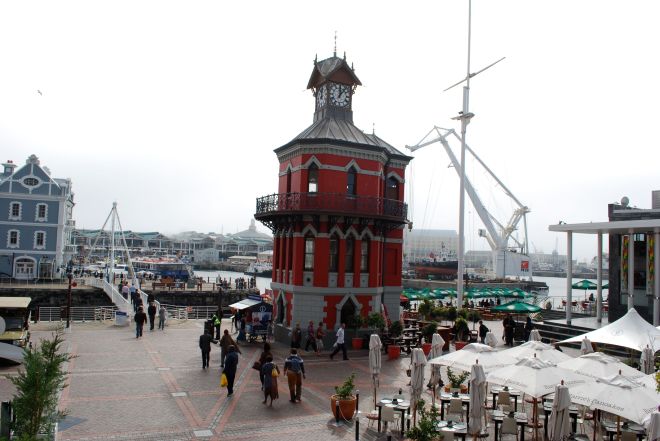
After nearly bumping into several pedestrians on Long Street, it came to my attention that not only do South Africans drive on the left side of the street — they also walk on it. This knowledge was helpful for the remainder of my trip down to the V & A Waterfront, a recently revitalized area on the Atlantic Ocean.
dsc_0182a

DSC_0184

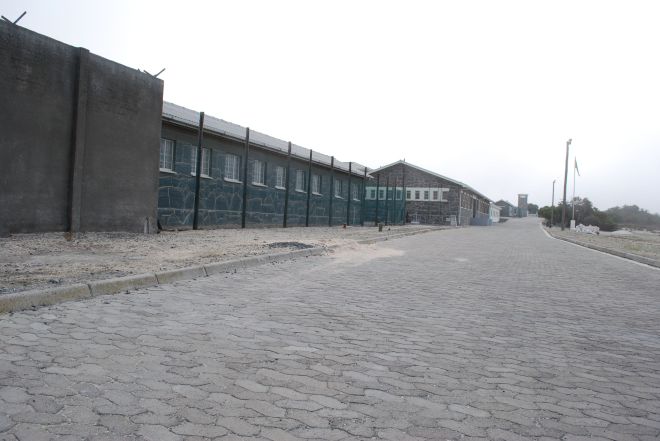
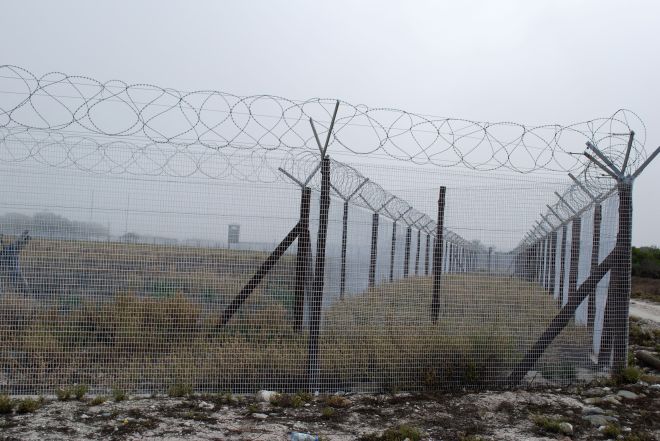
My boat to Robben Island left at 1 p.m. The island’s name is Dutch for “seals,” thousands of which once called it home. It’s more notorious, however, for the maximum security prison that once housed political prisoners, including Nelson Mandela, during apartheid. Unsurprisingly, with such a history, it’s a stark, terrible and powerful place.
dsc_0206a

dsc_0207a

Our guide was a former political prisoner, who spent five years locked up on fabricated charges of sabotage. He shared stories of a truly difficult life here before bringing us to the cell of the island’s most famous resident, Mandela.

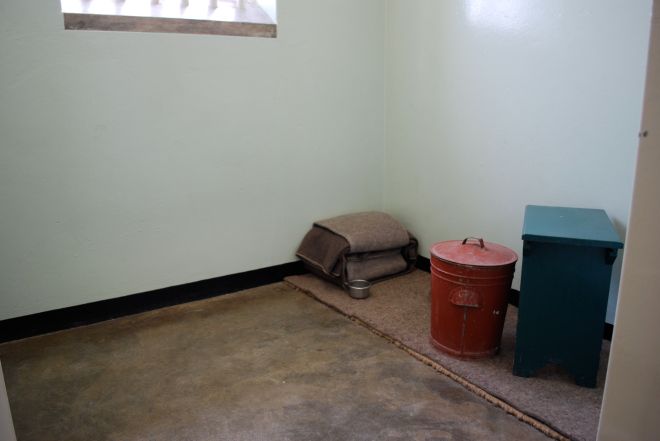
dsc_0200a

dsc_0202a

A 30-minute boat ride brought me back to shore. From there, the walk back was long but my timing was perfect. As the cable car brought me to the top of iconic Table Mountain, the sun slowly set and clouds rolled across the water.

dsc_0220a

dsc_0216a

dsc_0222a

dsc_0228a

Dinner with Erin and Sarah was at Jardine, consistently rated one of the top restaurants in South Africa. We had trouble trying to pick from an overwhelming menu and our waiter walked us through the dishes in delicious detail.

Then, a final decision was made. First, appetizer: An aubergine (eggplant) and zucchini stuffed baby calamari with a carrot cake pureé and spiced bread crumbs (delicious).

dsc_0229a

Being in Africa, it was only appropriate that I order the seared wildebeest loin with celeriac pureé, braised cabbage and pomme parmentier. The meat tasted game-y but was tender and complemented the celeriac, which had a mashed potato texture.
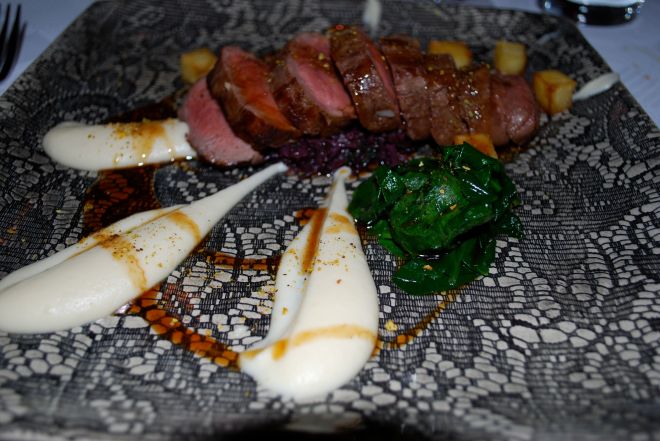
dsc_0232a

For dessert, we ordered a half hour in advance and were treated to a grand marnier soufflé flambé, a sweet and fiery finish.
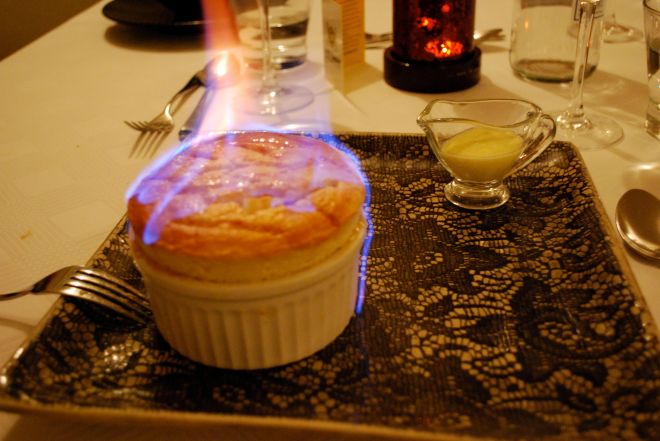
dsc_0234a

In what was a fitting end to the day, dinner showcased how far this city has come — and what its future may hold.

Arrival in the Mother City

Cape Town, South Africa

“You ready for your 15-hour flight?” the TSA rep asked me at the JFK security checkpoint. It sounded ominous — especially given the fact that I’d woken up at 5 a.m. this morning and had already been traveling for 5-hours. “You bet,” was my weak response.

The Airline Gods were looking down on me though. Checking in several hours before my scheduled flight offered one priceless advantage: the last emergency exit seat on a packed 777 airplane. Stretching my legs out with a good four feet of legroom, the woman sitting across from me looked longingly. “Poor man’s first class,” she said. “You bet,” was my more confident reply.

Nearly 15 hours and 7,967 miles later, we touched down in the sprawling metropolis of Johannesburg. After a quick push through customs, it was off to the domestic terminal to catch the 2-hour flight to Cape Town. Needless to say, it was a relief to arrive there at 1:10 p.m. local time, about 28 hours after my departure from D.C. yesterday.

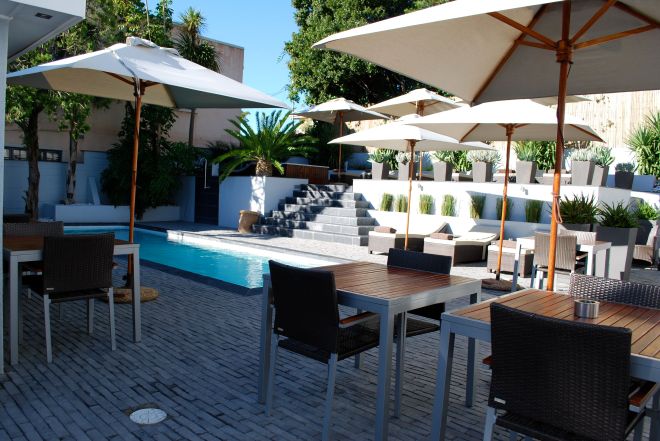
My friend Erin, and her roommate Sarah, met me at the airport in the Tazz, their amazing foam-green car. The sky was a vibrant blue and the sun was shining when we got to 2inn1, my guesthouse in Oranjezicht, an upscale residential neighborhood just north of the city center.

DSC_0171

DSC_0168

DSC_0170

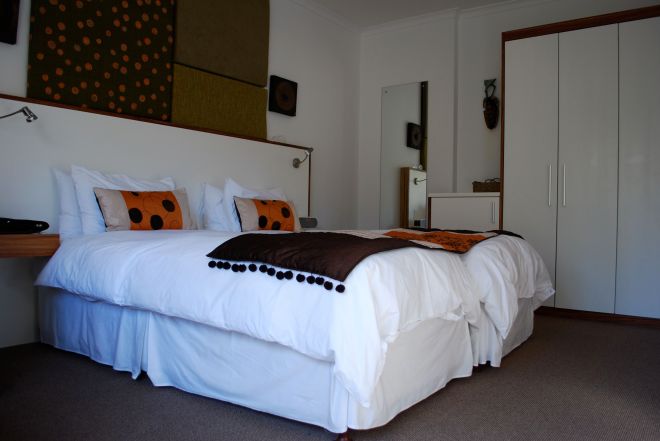
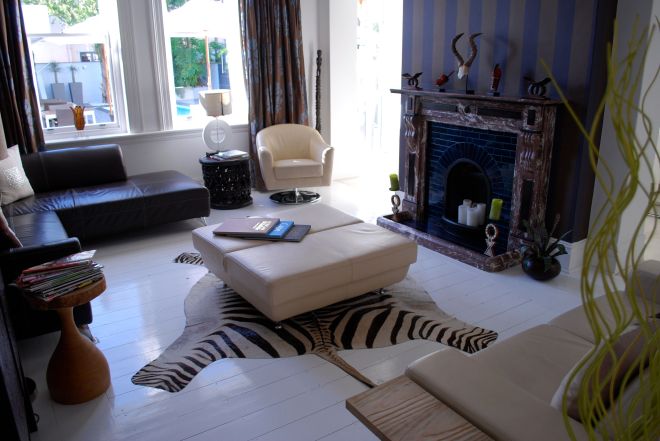
Since it wasn’t full, the friendly German owners upgraded me to a luxury room, which with its modern décor, private deck and views of Table Mountain, was right up my alley.

DSC_0162

DSC_0164

Walking around after, it was easy to see why Cape Town is cited as a great first city to transition into the African continent. At times, it felt no different than any other place; but, electric fences running along the top of high walls and security guards watching over parked cars provided a reminder of what the reality is like here.

Dinner was at Nova, whose chef, Richard Carstens, has won international acclaim and praise for his inventive cuisine. Each item on the “deconstructed” menu was simply a word with a list of a few of the other ingredients.

My “Spinach” appetizer was a salad with goat cheese, pomegranate, artichoke and mustard. The “Rib Eye” was dusted in coriander and cooked a perfect medium, served over salted apricots and Japanese curry infused mashed potatoes. Perhaps most interesting was the intermediary palette cleanser — a water crest and melon sorbet. Strange but surprisingly delicious.

Exhaustion and a full belly meant no dessert.

It was time for some sleep.

Overlanding through Africa

Washington, D.C.

A little after 5 a.m. this morning, I’ll embark on a month-long trip to Southern Africa with a short commuter flight to New York, followed by a South African Air direct flight to Johannesburg and connection to Cape Town. Door to door, it should run an impressive 30 hours.

Done with my first year of business school, I’ll be traveling for the next 31 days through South Africa, Namibia, Botswana, Zimbabwe, Zambia and Mozambique. My plan is to overland much of the journey — starting in Cape Town, South Africa I’ll rent a car and visit the Winelands before embarking on the iconic Garden Route (through Hermanus, Swellendam, Knysna, Plett and PE). From there, I’ll fly to Windhoek, the capital of Namibia, and drive through most of that country, with stops at Sesriem, Walvis Bay, Swakopmund, Damaraland and Etosha.

The second half of the journey, I’ll 4×4 from Windhoek through much of Botswana — stopping in Maun, the Okavango Delta and Chobe National Park — before terminating at Victoria Falls in Zimbabwe and Zambia. My last week will be spent aboard a sailboat in the Bazaruto Archipelago, a chain of islands in the Indian Ocean off the coast of Mozambique. Hopefully, a relaxing end to a whirlwind month.

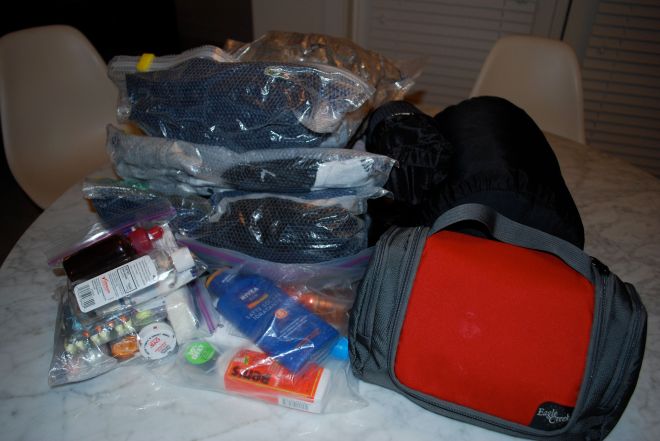
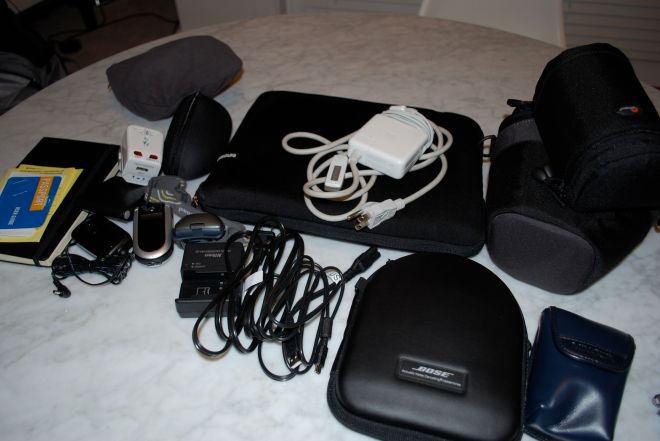
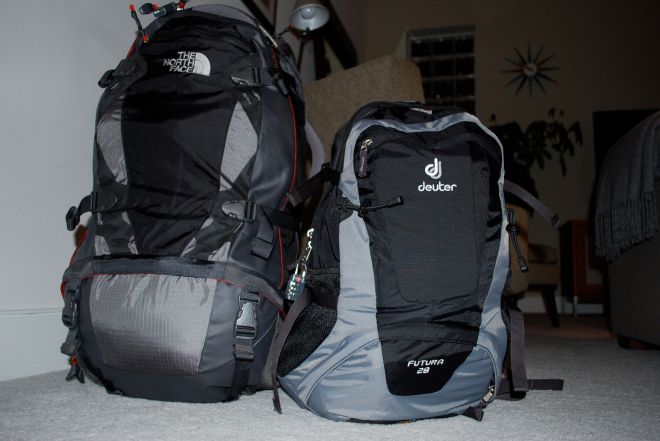
I’ve packed as light as possible for this trip, similar to my trek in Patagonia. There are Patagonia capilene shirts, a North Face sleeping bag and a bunch of new gear, including a Joby Gorillapod. It’s all been packed up in my North Face Backtrack 70 (recently replaced under warranty) and a new addition: a Deuter Futura 28, with an amazing airmesh frame.

Here’s what we’re talking about:

dsc_0118

dsc_0118

dsc_0118

And we’re off!